Difference between Ayushman card and ABHAA Card 2026?
Ayushman Card Healthcare accessibility and affordability are vital concerns in India. To support citizens, the Government of India launched several initiatives, including the ABHA (Ayushman Bharat Health Account) Card and the Ayushman Bharat Card under the PMJAY (Pradhan Mantri Jan Arogya Yojana) scheme. While many people confuse these two cards, each serves a distinct purpose and offers unique benefits.
What is the ABHA Card?
The ABHA Card, also known as the Health ID Card, is part of the Ayushman Bharat Digital Mission (ABDM). It provides a digital storage system for an individual’s medical records, eliminating the need to carry physical files, prescriptions, and test reports.
Every ABHA Card comes with a unique 14-digit identification number that allows authorized healthcare providers to access your digital health records securely. This card acts as a personal health repository, storing:
Key Benefits of the ABHA Card
Centralized Health Records: All medical data is securely stored digitally, preventing document loss.
Controlled Sharing: You can grant access to doctors only when needed.
Fast Hospital Registration: Pre-stored details accelerate check-ins and hospital processes.
Telemedicine Support: Doctors can review your history remotely, enabling online consultations.
Insurance Claims: Digital records simplify and speed up insurance claim processes.
Government Scheme Integration: Easier access to various health schemes without extra paperwork.
Verified Doctors: Connect with certified professionals in the ABDM network.
Complete Care: Enables doctors to plan treatments effectively based on full medical history.
Anyone in India can create an ABHA Card. Access is possible via ABHA ID, ABHA Address, or the ABHA mobile app.
What is the Ayushman Bharat Card?
The Ayushman Bharat Card is issued under the Pradhan Mantri Jan Arogya Yojana (PMJAY) and provides cashless healthcare benefits for eligible families. Each family enrolled under PMJAY can receive free treatment up to ₹5 lakh per year at empanelled public and private hospitals across India.
Key Features of the Ayushman Card
Eligibility for this card is restricted to families identified under government guidelines and registered in the PMJAY database.
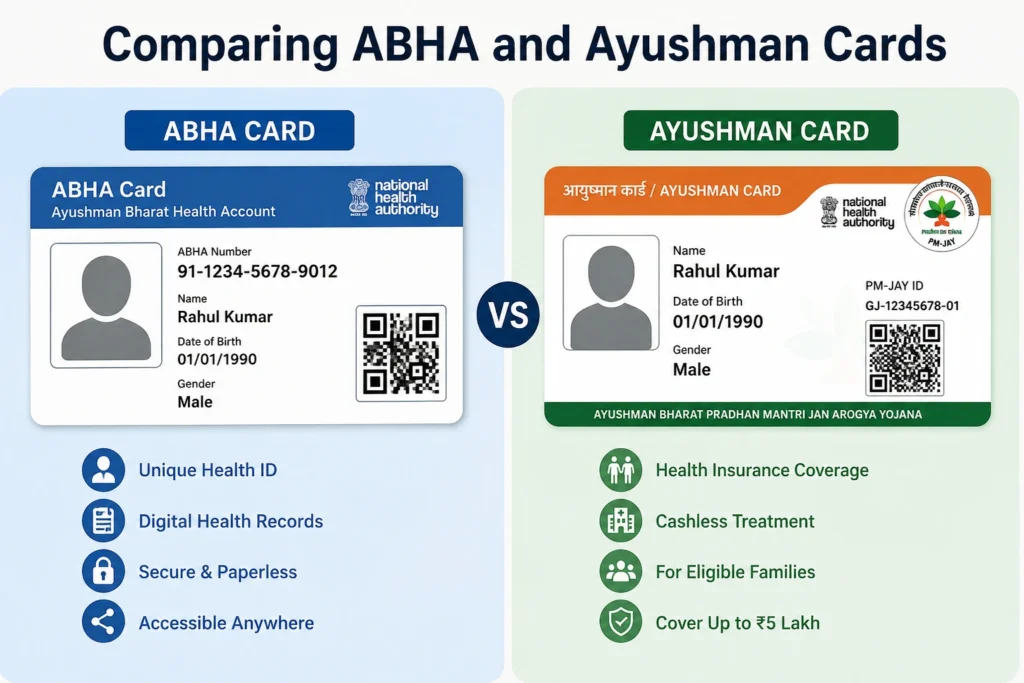
Comparing ABHA and Ayushman Cards
| Feature | ABHA Card | Ayushman Card |
| Purpose | Digital storage of medical records | Free or cashless hospital treatment |
| Eligibility | Any Indian citizen | Economically weaker families under PMJAY |
| Main Benefit | Health ID + online medical reports | Cashless hospitalization up to ₹5 lakh/year |
| Cost | Free | Free |
| Documents Required | Aadhaar or mobile number | Aadhaar + eligibility verification |
| Usage | Sharing medical records | Availing free medical treatment |
| Hospital Requirement | Any hospital using ABDM system | Only PMJAY empanelled hospitals |
| Medical Cost Coverage | No | Yes |
you can also read : Ayushman Card Odisha, Check eligibility, Download & Apply 2026
How to Apply
ABHA Card: Registration is simple online through the ABDM website. You can create an ABHA number using your Aadhaar, verify your mobile and email, and select a preferred ABHA address.
Ayushman Bharat Card: Eligible families can apply online through the official PMJAY portal, using Aadhaar and eligibility details for verification. Full step-by-step guides are available on the PMJAY website.
Which Card Should You Have?
For complete healthcare management, having both cards is recommended:
- ABHA Card: Organizes your health records digitally and ensures smooth interactions with doctors and hospitals.
- Ayushman Card: Provides financial protection and cashless treatment in hospitals, especially useful in emergencies or major medical expenses.
FAQs
Conclusion
While both the ABHA and Ayushman Cards are part of India’s digital healthcare evolution, they serve different roles. The ABHA Card focuses on digital record management, whereas the Ayushman Card ensures financial coverage for medical treatment. Together, they provide a seamless, efficient, and cost-effective healthcare experience for Indian citizens.